| Â
May 4, 2006
Paul Keith Davis: "The Primary
Redemptive Names of God"
Â
 Jehovah
Rohi - The Lord, My Shepherd (Psalms 23:1) Jehovah
Rohi - The Lord, My Shepherd (Psalms 23:1)
Although Israel learned to magnify the Lord for life, healing, victory,
holiness, peace, and protection, they were still pilgrims, and they were in dire
need of divine provision in their wilderness journey with all its weariness,
physical needs, duties, dangers and difficulties. Thus, there came the
revelation of God as their Jehovah Rohi, the
One whose Shepherd's love, care, and resources they could depend upon in all the
un-trodden and unknown pathways of the future.
Thus the Lord is the feeder to provide for us, keeper to protect us, companion
to cheer us, friend to help us, pastor to comfort us, and herdsman near to us,
as His frequent revelations prove.
Psalms 23 contains eight redemptive names of
Jehovah:
1)Â Jehovah Rohi
- "Jehovah is my
shepherd...."
(Psalms 23:1)Â
2)Â Jehovah Jireh
- "I shall not
want." (Psalms 23:1)
3)Â Jehovah Shalom - The Lord is my
peace. Â (Psalms 23:2) "He makes me to lie down in green
pastures. He leads me beside still waters."
4)Â Jehovah Rophi - The Lord, my
healer. (Psalms 23:3) Â "He
restores my soul."
5)Â Jehovah Tsidkenu - The Lord is
righteousness. (Psalms 23:3) Â "He leadeth me in paths of righteousness for His name's
sake."
6)Â Jehovah Nissi - The Lord is my
banner. (Psalms 23:5)Â Â "He prepares a table before me in the presence of my enemies."
7)Â Jehovah M'Kaddesh - The Lord my
sanctifier. (Psalms 23:5)Â
"He anoints my head with
oil."
8)Â Jehovah Shammah - The Lord is there.
(Psalms 23:4)Â Â "...thou art with me."
Jehovah Jireh
- The Lord Will Provide
(Genesis 22:14)
The definition of this term
is "The Lord will see" or "The Lord will provide". For man, this conjunctive
meaning seems impossible. However, for the all knowing God of creation, the dual
meaning is easily exemplified.
His pre-vision means His pro-vision. That was Abraham's revelation given to the
place where He found the ram provided as a substitute for Isaac. This miracle
was not of a normal significance; but rather it was a creative miracle by God
for the sacrifice, in the same sense that the Lord created a body through the
miraculous conception for the substitute sacrifice for man.
As Elohim, God demanded the sacrifice of
Isaac, but as Jehovah He made complete provision of a substitute for the son
Abraham willingly offered. The place of this miracle is important. It is the
first recorded instance in scripture of the naming of a place after a divine
interposition or manifestation.
Jehovah Tsidkenu - The Lord Our
Righteousness (Jeremiah 33:16)
In the Old Testament, there is evident revelation of Israel as being a nation
seeking after righteousness. Yet in their passionate desire for righteousness,
the people discovered their own unrighteousness. Therefore, we become people who
seek after purity of heart, so we can enjoy communion with God.
"Blessed are the pure in heart for they shall see God."
(Matthew 5:8)
The Greeks sought after wisdom, and the Romans pursued power and world dominion;
but today there is a remnant of God's chosen people who seek after God and His
righteousness.
To the glory of the gospel, is that Jehovah Tsidkenu
became flesh and was made unto us righteousness.
(1 Corinthians 1:30) A righteous God pronounced death as the
penalty of sin--yet that same God became flesh, the righteous branch, to taste
death for every sinner and to provide the righteousness that is transferred or
imputed to the believer and is thereby accepted before God. Acceptable
righteousness; therefore, is not attained but obtained.
Jehovah Shalom
- The Lord Our Peace
The word "Peace", and words directly
related to it, appear over 400 times in scripture. It is one of the most
precious and fundamentally essential ingredients for a believer to be at peace
with God and know the peace of God. It relates to a harmonious relationship
obtained through reconciliation of a debt paid in full. Peace or "Shalom" is
often translated--welfare, good health, prosperity, favor, rest whole, finished,
restitution or repay and perfect.
Jehovah Rophi
- The Lord Our Physician
(Exodus 15:26)
From Israel, we learn that in times of sickness God heals, for He is our
Jehovah Rophi, "I
am Jehovah thy healer". To express God's grace in restoring spirit
life, He declared that He healed all of our diseases, spiritual as well as
physical. (Psalms 103:3)
He also heals the broken in heart (Psalms 147:3),
and for those who are backsliding, He is their healer as well
(Jeremiah 3:22). The scriptures also clearly
indicate the removal of bodily infirmity (Genesis
20:17;Â Matthew 4:23).
Jehovah Nissi
- The Lord Our Banner
(Exodus 17:15-16)
Moses took care that God should have the glory for the victory over Amalek.
Instead of setting up a trophy in the honor of Joshua (though it had been a
standard policy to put marks of honor upon men), he built an altar to God's
honor. What is most carefully recorded is the inscription upon the altar,
Jehovah-Nissi - The Lord my Banner. The
presence and power of Jehovah were the banner under which they were enlisted,
and the banner by which they were kept together.
Jehovah Nissi in literal Hebrew means "A
hand upon the throne of Jehovah". Jehovah will have war with Amalek from
generation to generation. Amalek's hand had dared to assault Jehovah's throne to
overturn it, so He gave Israel the authority and power of that throne to
overwhelm Amalek. The uplifted hands of Moses symbolized this banner. Here we
have an illustration of the hand of faith outstretched in prayer.
Jehovah M'Kaddesh - The Lord Who Sanctifies
(Exodus 31:13
The term holiness is from the Hebrew word "Kodesh" and is allied to "sanctify".
It is translated as dedicate, consecrate, hallow, and holy in various
translations. "I am Jehovah M'Kaddesh - The Lord who
sanctifies you". This term's main influence relates to moral and
spiritual purity. In the New Testament, many scriptures relate to the process of
sanctification, the sum of which are provided to the church through the atoning
work of Christ:
SANCTIFIED By Truth (John 15:3; 17:17)
SANCTIFIED By the Blood (Hebrews 13:12)
SANCTIFIED By Faith (Acts 26:18)
SANCTIFIED By Prayer (I Timothy 4:5)
Jehovah Tsebahoth - The Lord of Hosts
(I Samuel 1:3)
This term in Hebrew is taken from sabaoth, meaning host or hosts, with special
reference to warfare or service, and the word often appears as the Lord of
Hosts. This Hebrew term has also rendered armies. This reference for Jehovah appears 14 times in the book of
Haggai and 24 times in the book of Malachi.
In Zechariah, the Lord of Hosts occurs 53 times and is of great interest, seeing
that it is connected with God's action in judgment and blessing upon Israel. The
expression "Thus saith the Lord of Hosts", implied divine revelation and divine
authority; a phrase like "Holiness unto the Lord of Hosts",
(Zechariah 14:21).
When the conquest of Canaan was about to begin, the Lord was revealed as the
unknown warrior with naked sword standing before Joshua. When Joshua asked the
question, "are you for us or against us";
the reply came, "I am Prince of the Host of Jehovah",
therefore Joshua humbly surrendered his sword to
Jehovah Tsebahoth.
The whole of His creation is under His control and obeys His sovereign command,
willingly or otherwise. He is:
1)Â Lord of all angelic hosts (I Kings 22:19)
2)Â The Lord of all steller things (Genesis 1:16)
3)Â The Lord of all the feathered hosts (I Kings
17:2-7)
4)Â The Lord of all the animal hosts (Isaiah 11:6)
5)Â The Lord of all the human hosts (Isaiah 40:15)
6)Â The Lord of the satanic hosts (Matthew 28:18)
Jehovah Heleyon - The Lord Most High
Jehovah Heleyon is frequently used in the
Psalms as a declaration of God's highest position or kingship. This title
reveals God as the high and lofty one that inhabits eternity
(Isaiah 57:15). It is prophetically speaking
of Jehovah's reign over the earth at the time of Israel's restoration or the
restoration of God's chosen people.
It is also reassuring for us to know that during these difficult days, that the
Most High rules in the kingdom of men, also (Daniel
4:25). This redemptive name places God at the highest place of every
realm of life, so that He can fulfill His will in and through us. When applied
to God, this redemptive name reveals that though He is the highest, there are
others below Him endowed by Him with like natures, and therefore, in some way,
related to Him by His Spirit.
Jehovah-Makkeh - The Lord Who Smites
(Ezekiel 7:9)
The Lord has given Israel to us as an example of His dealings with man. He set
Israel in the midst of heathen nations as His witness, but instead of revealing
and glorifying Him, she changed His judgments into wickedness greater than all
the nations she was supposed to influence for Him. Therefore He said,
"You shall know that I am Jehovah-Makkeh", the Lord who
smites thee. (Ezekiel 7:9)
The 9th chapter of Daniel reveals that Israel found herself in captivity because
she refused to heed the voice of the Lord God, which was set before her by His
servants, the prophets. As a result of Israel's disobedience, the Lord smote
Israel and disciplined her because of her unbelief and rejection of His true
revealed word. The church has also experienced a similar disciplinary period
over the past forty years because of her rejection of the true revealed word as
brought to the church by His servants, the prophets.
The good news is His promise to restore. According to
Hosea 6:1-2, Come, let us return to the LORD. For He has torn us but He will
heal us; He has wounded us but He will bandage us. He will revive us after two
days; He will raise us up on the third day, that we may live before Him."
Jehovah Gmolah - The God of Recompense
(Jeremiah 51:6)
The scriptures declare that retribution or recompense does not belong to us but
rather it belongs to God. In Jeremiah 51, the Lord declares that He will
severely punish Babylon because of their harsh dealing with Israel, thereby
revealing Himself as the God of retribution.
The same was true of Egypt when they placed the nation of Israel under a heavy
burden and struck the apple of His eye. When a person is shamefully treated or
misjudged, even wrongfully condemned or blamed when innocent, it becomes very
difficult not to take up our own defense, and leave our reputation to God. Yet
this is the precise way that He has instructed for us to respond. Retribution
and recompense belong only to him. Vengeance is His, and He promised to repay
(Deuteronomy 32:35; 2 Thessalonians 1:8).
Jehovah Shammah - The Lord Is There
(Ezekiel 48:35)
The name of the city revealed through Ezekiel is Jehovah
Shammah - the Lord is There. This location is so named because of the
manifest presence and power of Jehovah residing there. We also know from
scripture that God does not dwell in temples made by hands, but rather we are to
be God's temple.
This is the last of Jehovah's redemptive titles in the order of their Old
Testament occurrence. It discloses the consummation of His progressive
self-revelation.
The people of Israel were brought out of the bondage of Egypt by His manifest
presence (Deuteronomy 4:37). However, the
people willfully and continually sinned, and the conscious manifest Presence of
God was rescinded. Yet when the people repented of their gross idolatry, because
of His love and pity, the angel of His presence redeemed them once again
(Isaiah 63:9).
The apostle Paul describes the church as a habitation of God, a house of God,
and the building growing unto a holy temple in the Lord.
The question remains: Does the Glory of Jehovah fill Jehovah's house, and are
we, members of that house, displaying His Glory?
by Paul Keith Davis
White Dove Ministries
www.whitedoveministries.org
~~~~~~~~~~~~
Paul Keith Davis' Upcoming
Itinerary:
May 10 - 20, 2006
Israel
May 26 - 27, 2006
New Life Bible
Pastor Randy Demain
www.whitedoveministries.org/content/BulletinCatColumns.phtml?c=13
May 31 - June 6, 2006
"Come Up Here" Conference
Toronto Airport Christian Fellowship
272 Attwell Dr.; Toronto, ON Canada M9W 6M3
Contact: 1 (866) 500-0003 / 416 674 8463 or www.tacf.org
|









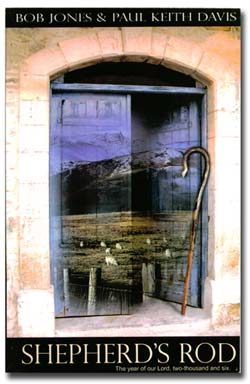
 "Shepherd's Rod 2006"
 NEWSLETTER