"Deep Within the
Land of Ireland is an Ancient Mantle and Gift for Peace; I Am Bringing it Forth."
-
A WORD FOR IRELAND,
MARCH 2005
by Catherine Brown
Gatekeepers Prayer & Mission,
www.gatekeepers.org.uk
Million Hours of Praise, www.millionhoursofpraise.com
Email: Catherine@gatekeepers.org.uk
"Peace I leave with you; my peace I give you. I do not
give to you as the world gives. Do not let your hearts be troubled and do not be
afraid."
John 14:27 (NIV)
 PEACE
PEACE
Whilst driving to the North East of Scotland the other day, I was enjoying a lovely
time of fellowship with the Lord. I began to think about St. Patrick's Day (www.prayonstpatricksday.com)
and asked the Lord for a word from His heart to help me pray for Ireland. The Lord
replied, "Child, my word for Ireland is peace -- not politics, not platitudes,
but My peace. Deep within the land of Ireland is an ancient mantle and gift for
peace. I am bringing it forth."
[Politics - the principles relating to or inherent in a sphere or activity;
especially when concerned with power and status. Platitude - n. a
trite, obvious or insincere remark or statement.]
I then had a vision of the United Kingdom and Ireland, and the word Transformation
was imprinted upon the land. God is building unity and will bring transformation
(www.transformations-ireland.org).
ANGELS WITH BOOTS ON!
Another vision appeared before my eyes as I saw angels wearing huge boots marching
up and down on the land. The ground was shaking with the force of their marching.
I asked Jesus where the angels were marching, and then I noticed a red hand under
the angels. The angels were marching in Ulster! As I looked more closely, I noticed
the hand had a number eleven (11) engraved on it.
The number eleven (11) is symbolic
of the spirit of lawlessness (Lawlessness because of the eleven evil years
that Kings Jehoiakim and Zedekiah reigned [II Kings 23:36; II Kings 24:18; II Chronicles
36:5; II Chronicles 36:11; Jeremiah 52:1]; Idolatry because of Micah's idol
[Judges 17]; Bribery, seduction, and allurement because of Delilah and the
eleven hundred shekels of silver from the Philistines [Judges 16:4-5]). The angels
had been given their "marching orders" and were contending for peace in Ulster.
The peace released in Ulster by the angels and the prayers of the saints will ricochet
across the whole of Ireland.
(Ulster, a former province of north Ireland, in the 5th century A.D. was the most
powerful of the five ancient kingdoms [see also Connaught, Leinster, Meath, Munster]).
GOD'S MERCY TO COVER THE MASSACRE OF
DROGHEDA
I asked the Lord about Southern Ireland and He spoke to me of Dublin. I saw a river,
which I believe is the site of ancient battles, and the Lord impressed to my spirit
that He also desires to dispatch angels to this site. This is a place where repentance
and reconciliation will release healing into the land.
I see a gathering of believers to
intercede and praise into this situation. Pray that the land and the people will
be healed from the battle scars of the Drogheda massacre (September 11, 1649) --
the killing of the defenders of Drogheda by the parliamentarians under Cromwell.
Drogheda, a port north of Dublin, was occupied by English and Irish royalists who
defied Cromwell's call to surrender. Cromwell then stormed the town and ordered
the killing of the 2,500 members of the garrison.
Pray for the church in Ireland to receive the gift of faith to believe that nothing
is impossible with God. Even though Ireland has been torn apart over the centuries
by conflict, Christ proclaims His peace! Jesus has deposited His peace in Ireland
(we may pray this with faith as we receive it as the promise of John 14:27). Pray
for unity between Northern and Southern Ireland.
"Many angels have been sent on assignment to Ireland, and many more are yet to
be dispatched. Pray for a release of my angels in Ireland, for there is much work
to be done. Thank Me for angels on assignment and for the promises of salvation.
Pray for My Spirit to be poured out and for the spirit of lawlessness to be broken
under My feet."
PRAYERS FOR IRELAND
-
Pray that the faith that St. Patrick
had and the relationship with God that he enjoyed would become the norm on the island
of Ireland and throughout the nations.
-
Pray that the island of Ireland would
be a welcoming place for the stranger and that many souls would be won to Christ
through compassion and acts of love and hospitality.
-
Pray that God would help His children
all over the island to see themselves as they really are - i.e. in His image.
-
Pray for the island of Ireland to
come into the fullness of God's purpose.
-
Pray for angels to be released on
assignment to minister to all those who will receive salvation.
-
Pray for the spirit of lawlessness
to be bound and a spirit of peace in Christ to be released in the mighty name of
Jesus.
-
Declare that the Blood of Christ cleanses
and heals the land and the people of Ireland.
Yours in Jesus' love,
Catherine Brown, Founder
Gatekeepers Prayer & Mission, www.gatekeepers.org.uk
Million Hours of Praise, www.millionhoursofpraise.com
Email: Catherine@gatekeepers.org.uk
~~~~
MILLION HOURS OF PRAISE UPDATE:
We are delighted that Ireland is part of our global praise initiative Million
Hours of Praise (www.millionhoursofpraise.com).
We currently have 36 nations on board with a cumulative praise total of more than
58,000 hours. I personally invite you to join us in raising praise to Jesus every
day! Make a praise pledge TODAY!
We warmly invite you to take part in the Global Day of Praise, June 25, 2005 --
have a praise party or praise parade and take the love of Christ out onto your streets.
-Catherine Brown
"ST. PATRICK - THE CELTIC
LION"
by Kathie Walters
Good News Ministries
www.goodnews.netministries.org
Email:
kathie@hom.net
 I
thought you might like a shortened version of Patrick's life, seeing as it's St.
Patrick's Day today.
I
thought you might like a shortened version of Patrick's life, seeing as it's St.
Patrick's Day today.
PATRICK'S CHILDHOOD
PATRICK was born of Christian parents toward the close of the fourth century. His
father, Calpurnius, though of British race was, by birth, a Roman citizen, and held
the rank Decurion. The father and grandfather of Calpurnias, Potitus and Odissus,
had both been Christians; so that the family had kept the faith for at least several
generations.
Conchessa, Patrick's mother, was a near relative of the great St. Martin of Tours.
She was a wise and good woman, and sought to bring up their children in the fear
and love of God.
As the son of a Roman Citizen, and a British noble, Patrick was bound to have had
some education. According to the custom of British citizens of the Roman Empire,
Patrick was given three names, rendered in Latin as Patricius, Magonus, Sacatus.
Patricius meaning "Noble," and Sacatus, a Celtic word, meaning "Valiant in war."
Patrick had a brother, Sannan, and five sisters. They all became servants of God
and the church.
Calpurnius dwelt at Bannavem Taberniae, which was near the rock of Dumbarton, or
in Wales. It was certainly in some part of Roman Britain or Brittany.
The fact that St. Patrick worked great and wonderful miracles is beyond question,
and those miracles won him enthusiastic admiration and enduring love of the people.
De Vere wrote long ago of Patrick:
"Beholding not alone his wondrous works,
But, wondrous more, the sweetness of his strength,
And how he neither shrank from flood nor fire,
And how he couched him on the wintry rocks,
and how he sang great hymns to One who heard,
And how he cared for poor men and the sick,
And for the souls invisible to men."
Miracles happened even over the birth of St. Patrick. As no priest was to be found,
the infant was taken to the blind hermit, Gornias, to be baptized. A difficulty
arose because there was no water to perform the ceremony. Gornias, however, by faith,
took the baby's hand and with it traced the sign of the cross upon the earth and,
as a result of, water gushed forth. Bathing his own eyes, the hermit saw, and he
then baptized Patrick.
From his childhood he had been able to understand the things of God. Patrick, in
the Book of Epistles, said, "And God had pity on my youth and ignorance, and
He took care of me before I knew Him, and before I could distinguish between good
and evil. And He strengthened me and comforted me as a father does his son."
Fostering was a custom peculiar to the tribal system of ancient Ireland and was
regulated by the Brehon laws, which ordained that the sons of nobles should be educated
in the homes of the tribesmen until they reached the age of seventeen -- the daughters
until their fourteenth year.
Although of noble birth, the child was not brought up in luxury. Patrick's foster
parents are represented as careful, thrifty people, perhaps living on the farm which
belonged to Calpurnius, and attending to his flocks and herds.
MIRACLES
At one time, when he was out playing in the ice and snow, he took some icicles in
his jacket and ran with them to his foster mother, thinking that she would be pleased.
She was irritated and told him that it would better to bring a piece of wood for
the fire. Patrick smiled sweetly and told her to trust God and the icicles would
start a fire. Very soon, a fire was roaring on the hearth.
Once when Patrick was minding sheep with his little sister, Lupita, she tripped
and fell, striking her head against a stone. Her brother was some distance away,
but when he returned and found her laying unconscious, he prayed over her and raised
her up. The wound was instantly healed, and the girl recovered. The scar remained
visible, as a proof of the miracle. The children returned home together as if nothing
had happened.
On one occasion, when the Britons had a meeting, his foster parents took him along
with them. While they were there, his foster father suddenly collapsed and died.
At first, a great hush fell upon the assembly, and then the man's relatives began
to weep. His wife cried, and calling to Patrick, she said, "My boy, why have you
allowed the man who has been so kind to you to die?"
Patrick had been playing with the other children and had not noticed, at first,
the distress of the people. But seeing what had happened, he ran to his foster father
and, putting his arm round the dead man's neck, he said affectionately, "Get up,
and let us go home."
The man arose at once and, full of life, he returned home with his wife and boys.
SOLD AS A SLAVE
When Patrick was sixteen years old, the Picts and Scots began to raid the coast,
plunder, and take hostages. One of the most victorious of these "sea kings" was
Niall, surnamed "Of the Nine Hostages" (because he took hostages from nine places).
It was during one of Niall's raids that Patrick was taken hostage one day, along
with a maidservant, his sister Lupita, and some other companions.
He was taken by ship to Ireland, somewhere along the coast of Antrim, and sold as
a slave to a petty king -- Milcho. He was put in charge of a herd of swine and so
spent most time out in the fields. But it was there that God was made real to him
and, as he said later, his eyes were opened to see his unbelief, and he was truly
converted. All of the Scripture which he had learned as a child flooded his mind
and heart and he decided then that, somehow, he would become a servant of God.
Milcho was so impressed with Patrick that he asked him to teach his children to
read; but Milcho was a druid and opposed to Christianity, which was spreading across
Ireland.
VICTOR, THE ANGEL, SPEAKS TO PATRICK
Patrick had many conversations with
the angel of Ireland, named Victor. One night,
after six years, he heard a voice, the angel Victor, who said, "Soon you will return
to your country." A while later the same voice spoke to him again, "Your ship is
ready." He managed to escape, trusting God, and made his way to the coast. After
a few days he found a ship ready to sail and, after some hassles, he was taken on
board.
Eventually Patrick, after months of journeying, arrived home. His parents had died,
but his relatives welcomed him.
One night he was awakened by the same angel, Victor, whom he had known in Ireland.
He was standing beside Patrick's bed holding many letters in his hand; he selected
one and handed it to Patrick. It read, "The Voice of the Irish." Then he heard many
voices calling to him to come back to Ireland and bring the message of the Gospel.
PATRICK RETURNS TO IRELAND FOR GOD
Finally, God provided a way for Patrick to return to Ireland in 432 A.D.
So the ministry to the Irish began, not without opposition from the druids and wizards,
who tried desperately to keep Patrick away from the kings, for they had prophesied
of his coming. Patrick believed that if the kings could be won for God, then the
people would follow.
SPIRITUAL BATTLES FOR IRELAND
One of the first spiritual battles between Patrick and the Druids was fought at
the Hill of Tara, in 433 A.D.
The High King Laeghaire (Leary), son of the renowned Niall of the Nine Hostages,
had invited the sub-kings and nobles and bards to a lavish festival. It was to start
with great bonfires, but until those fires were lit by the druids, it was forbidden
for other fires to be seen.
King Laeghaire, in his efforts to hold his power over the lower kings, had given
himself to the power of the wizards and skillful magicians and Druidic priests,
along with their idols.
Lochru and Lucat-Mael were his chief wizards and, being false prophets, they had
foretold that "An evil teacher would come from over the sea to their land; that
a multitude would receive him, and that he would find love and reverence from the
men of Ireland. He would cast out from their realms the evil kings and lords, and
would destroy all the idols. The worship established by him would abide in the land
forever."
No doubt the druids knew of the progress of Christianity in Britain and Europe.
Their brethren abroad had been discredited and they were afraid of the same fate.
They were very much afraid of losing their influence and authority.
PATRICK LIT THE EASTER FLAME
Patrick, leaving the friendly hospitality of Dichu, sailed southward and arrived
at Inver Colptha, the mouth of the river Boyne. They followed the course of the
stream for about 12 miles until they came to the hill of Slane, where Patrick proposed
to celebrate Easter.
While they rested there on the hill, they saw the magnificent view beneath of the
river Boyne; to the north, far away, were the purple mountains of Mourne, and to
the south lay the beautiful hills of Wicklow. Against this background, about 10
miles away, stood the royal hill of Tara. The roofs of the palaces were shining
in the setting sun.
When the sun had set, Patrick prepared to begin the celebration of the Resurrection
of Christ. It was the first time the paschal fire was lit, never to be extinguished
in the land.
Hardly were the Christian torches seen to blaze, when the attention of the High
King was drawn to the scene. The whole of Mag Breg (the Beautiful Plain) was illuminated
by the fires while Tara was still in darkness.
Angrily, the King called his attendants and told them to find out who had dared
to light the fires and break the law he had made for the occasion of the festivals
of Beltane and Samhain.
The wizards told King Laeghaire that there was no need to send messengers to Slane
for they knew what the fires were. "We see the fire," they said, "and we know that
unless it is quenched on the night in which it is made, it will not be quenched
forever. The man who kindled it will vanquish the kings and lords of Ireland, unless
he is forbidden."
"This shall not be!" cried the king. "But we will go down and kill this man who
made the fires."
The horses were hastily made ready.
Meanwhile, on the hill of Slane, Patrick had begun with the others the celebration
of the Easter festival, singing and worshiping God.
THE OPPOSITION OF THE DRUIDS
AND THE KING OF TARA
It was late when nine chariots, bearing the king and queen with two chief Druids,
and a number of nobles, came thundering toward Slane. The wizards began to fear
that the king might fail by taking a hasty action.
As they drew toward the Christians,
the druid wizards spoke to King Laeghaire, "You should be careful," they cautioned
the king, "not to go down to the place where the fire was made, and give any respect
to the man who kindled the fire. Stay outside and have him brought out to you, so
that he will know that you are the king, and he is the subject." The king was flattered
and agreed.
They drove to the place called "The Graves of Fiacc's Men," and they unyoked the
horses. The king and his nobles sat in solemn state, and the warriors stood with
their shields erect in front of them. In the light of the fires they looked very
fierce. The king forbade anyone to rise to greet Patrick or any of his company (contrary
to the custom of the Irish). A messenger was sent to fetch Patrick.
Soon a bright procession appeared descending the hill. As Patrick advanced, all
eyes were fixed on him. Calmly he sang as he approached the king, "Some trust in
chariots, and some in horses; but we will call upon the Name of the Lord our God."
As Patrick's clear strong voice resounded, a feeling of awe filled the minds of
the warriors. One man, Erc, the son of Deg, rose to greet Patrick. By grace, in
a moment, he believed in God, and Patrick blessed him. Later on he was baptized
and eventually became the first bishop of Slane. Patrick prophesied to him, "Your
city on earth will be high and noble."
After a "formal" greeting between Laeghaire and Patrick, the wizard Lochru attacked
him angrily with contention and shouting. He became malicious and hostile, and even
violent, blaspheming the Holy Trinity. Patrick's anger was roused and he called
upon God, "O Lord, Who can do all things, and on Whose power everything depends,
You have sent us here to preach Your Name to the heathen. Now let this ungodly man,
who blasphemes your Name, be lifted up and let him die."
No sooner had Patrick finished speaking than a supernatural force raised the wizard
in the air. He fell heavily down, his head striking a stone. And so he died in the
presence of those assembled.
The heathen seeing their own subdued, and realizing that Patrick had more powers
than the druids, were greatly affected.
But the king was enraged at the fate of Lochru, on whom he had greatly depended.
He then wanted to take the life of Patrick. "Slay this man," he cried to his guards.
THE GROUND SHOOK WITH AN EARTHQUAKE
But Patrick stood firmly in his place. With flashing eyes and resonant voice he
said, "Let God arise and His enemies be scattered. Let them that hate Him, flee
from before His face! As smoke vanishes, so let them vanish away: as wax melts before
the fire, so let the wicked perish at the presence of God."
By this time the sun had begun to rise and the morning splendor bathed the earth.
But at the words of Patrick, darkness crept back over the sky and the ground shook
with an earthquake.
The swords and spears of the warriors clashed against their shields and it seemed
to them that sky was falling down, and there was no hope of escape from impending
destruction. The frightened horses galloped away in wild confusion, and the wind
blew so fiercely that the chariots were moved.
Because of the confusion and fear, the warriors began to fight among themselves,
and some were killed. Realizing their mistake, they fled, leaving only three people
with King Laeghaire and Queen Angas.
The king remained sullen and silent, but the queen rose and approached Patrick.
She spoke to him with respect. "Just and mighty man," she said, "do not destroy
the king. He will come to you and he will do your will and he will kneel and believe
in your God." Her influence prevailed and, because the events of the past few hours
had shaken him, the king kneeled before Patrick, offering peace. It was a false
gesture, designed to allow him to avoid the present situation.
Laeghaire designed a plan in his mind to try and kill Patrick on the way to his
castle. "Follow after me, to my castle, Cleric," said the wily king, "and at Tara
I may believe in your God in the presence of the men of Ireland."
Patrick consented and Laeghaire gave orders to his servant that an ambush should
be set on several paths between Slane to Tara. The chariots were yoked once more
by the attendant who had now returned, and the royal party set out back to the palace.
They were very weary and discouraged after their disastrous night with Patrick.
PATRICK'S VICTORY
Patrick and his company continued the interrupted Easter Day celebration with hearts
full of gratitude to God. Then Patrick selected his companions and blessed them
before setting out for Tara. There were eight young clerics, including Patrick,
and the boy, Benignus, who never left Patrick's side. They had ten miles to walk,
"but God covered them with a cloak of darkness," so that they could not be seen.
God had revealed to Patrick the evil design of the king.
The king's servants, as they watched, saw only eight deer and a fawn (Benignus).
It was after this that Patrick wrote his famous hymn, "The Deer's Cry," in which
he gave God praise and expressed his firm belief in the Resurrection, the Incarnation,
and Death and Ascension of Christ. He declared glory to God, who was his defense
against the wiles of the devil and against all forms of superstition and idolatry;
ending with an appeal to Christ to be with him always and speak to him through every
creature.
The battle between Patrick and King Laeghaire and his evil magicians continued over
the next few days, after the great feasts at the castle in Tara. At the end of the
feast, the king arranged a competition between the wizard, Lucaet-mael, and Patrick.
After many demonstrations on the part of both men, Lucaet-mael was killled and Patrick
came off victor. The king and many of his subjects became Christians and Patrick
went away with permission to evangelize Ireland.
RAISING THE DEAD, AND WINNING DUBLIN
He spent the year (433 A.D.) preaching the Gospel, winning the sub-kings and nobles
over to the Christian faith and, consequently, the people. He constantly managed
to escape from those who wanted to kill him, and gave demonstrations of the power
of God, with great miracles everywhere.
When Patrick grew weary, the angel who was his companion (Victor), would bring words
of encouragement. One time he spoke to Patrick saying, "You will have everything
around to which you will go; every land; both mountains and churches; both glens
and woods and waters. Though you are weary, still you will go further."
His prayers were powerful because his humility was great. He healed the sick, delivered
the oppressed, and raised the dead.
When Patrick went to Dublin, then a small village, the king, who had previously
refused to accept the Christian message, welcomed him. The king's son had died that
week in his own bedroom through sickness, and his young daughter had drowned in
the nearby river. The king challenged Patrick to raise his children from their death-beds,
promising that if he did, he and his people would serve God and be baptized. Patrick
obliged, and Dublin was won. Patrick prophesied that Dublin would become a great
city one day.
PATRICK'S DEATH AND LEGACY
Many of the Celtic Saints, because of their close relationship to God, knew when
they were going to die, and would make arrangement to go to the place which they
felt was for their resurrection. In Patrick's case, he felt that he should die in
Armagh, a place he was deeply attached to. He started to make arrangements to get
there, but the angel Victor forbade him saying, "It is not there that your resurrection
is granted to you; go back to the place from which you came, namely Dichu's Barn.
But God has granted that your name shall be known and your teaching shall be in
Armagh, as if you were still alive in it." So it has been since that time.
Patrick returned to Saul, to Dichu's Barn, on Strangford Lough, where he had made
his first celebration in Ireland. He gave thanks to God, received Holy Communion
from Bishop Tassach, and then gave up his spirit to God. The Tripartite Life sums
up Patrick's life in the following words:
"Now after founding churches in
plenty; after consecrating monasteries, after baptizing the people of Ireland; after
great patience and labor; after destroying idols, and rebuking kings who did not
do the will of God; after ordaining three hundred and seventy Bishops, and three
thousand priests, ministers and laymen; after fasting and prayer; after mercy and
clemency; after love of God and his neighbor, he gave up his spirit to God."
It is said that for the twelve nights
of his funeral rights, an angelic radiance was seen around his body.
Before he died, on March 17th, 471 A.D., Patrick made this confession:
"If I ever accomplished anything good, for the sake of my God, Whom I love, I
ask Him to grant that I can shed my blood with the strangers and captives for His
Name's Sake. If I, Patrick the sinner, have done any small thing according to the
will of God, I attribute it to the gift of God alone. And this is my confession
before I die."
by Kathie Walters
Good News Ministries
E-mail: kathie@hom.net
www.goodnews.netministries.org
~~~~
Reference sources:
St. Patrick - Apostle of Ireland - The Irish Tripartite Life of Patrick - Stokes
Legends of Patrick - Aubrey de Vere. Life and Writings of Patrick - Arch. Healey
Lives of the Irish Saints - O'Hanlon





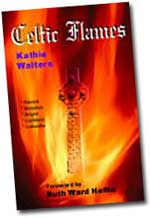
 "Kathie,
in her book, takes us far into the past and reminds us that God doesn't need
flawless vessels through which to reveal Himself -- only willing ones. This book
is a must-read for every believer -- those walking in faith and those needing
to. I recommend it highly." - Iverna Tompkins
"Kathie,
in her book, takes us far into the past and reminds us that God doesn't need
flawless vessels through which to reveal Himself -- only willing ones. This book
is a must-read for every believer -- those walking in faith and those needing
to. I recommend it highly." - Iverna Tompkins "Kathie
Walters has an amazing ability in her writings to ignite a fresh fire in your
heart. The fire of the Lord was lit in Ireland through a bold and godly group of
men and women, as they gave themselves wholeheartedly to prayer and ministry.
Kings and rulers were won because of them and the fires were lit through there
lives." - Suzanne Hinn
"Kathie
Walters has an amazing ability in her writings to ignite a fresh fire in your
heart. The fire of the Lord was lit in Ireland through a bold and godly group of
men and women, as they gave themselves wholeheartedly to prayer and ministry.
Kings and rulers were won because of them and the fires were lit through there
lives." - Suzanne Hinn "I
am confident that the life of these Celtic saints of old are relevant to us
today. They fearlessly took their stand against all the hordes of hell, and laid
claim to what they believed was God's territory." - Gwen Shaw, Founder,
End-Time Handmaidens & Servants
"I
am confident that the life of these Celtic saints of old are relevant to us
today. They fearlessly took their stand against all the hordes of hell, and laid
claim to what they believed was God's territory." - Gwen Shaw, Founder,
End-Time Handmaidens & Servants


 Subscribe to the Elijah
List Here
Subscribe to the Elijah
List Here